
India recorded a current account surplus of $5.7 billion or 0.6 per cent of GDP in the March quarter, the Reserve Bank of India said on Monday. This is the first time in ten quarters that the crucial metric of the country's external strength has turned into surplus mode. In the year-ago period, the current account deficit stood at $1.3 billion or 0.2 per cent of GDP, and the same was $8.7 billion or 1 per cent of GDP in the preceding quarter ending December 2023.

Growth of eight key infrastructure sectors slowed down to 8.2 per cent in June 2023 compared to the year-ago month due to a decline in the production of crude oil, according to the official data released on Monday.

The country's real GDP growth in the first quarter will be better than the Reserve Bank's estimate of 8 per cent, economists said on Tuesday. Economists at the country's largest lender SBI pegged the growth at 8.3 per cent while domestic rating agency Icra estimated it to come even higher at 8.5 per cent. The Reserve Bank of India (RBI), which expects the GDP to grow at 6.5 per cent in FY24, has estimated a growth of 8 per cent in the April-June period.

The December meeting of the Reserve Bank of India's (RBI's) six-member Monetary Policy Committee (MPC) will start on Wednesday even as there is no clarity on whether Governor Shaktikanta Das, the chair of the panel, will continue in office after his term ends next week. The outcome of the meeting will be announced on Friday by Das at 10 in the morning.

Retail inflation eased to an 11-month low of 4.83 per cent in April as prices of some kitchen items declined though overall food basket firmed up marginally, according to a government data released on Monday. The Consumer Price Index (CPI)-based retail inflation was 4.85 per cent in March. It was 4.7 per cent in April 2023.

The growth of eight key infrastructure sectors rose to a 14-month high of 12.1 per cent in August 2023 against 4.2 per cent a year ago, mainly due to expansion in production of coal, crude oil, and natural gas, according to the official data released on Friday. The expansion in August is the highest since June 2022, when it was 13.2 per cent. The production of refinery products, steel, cement and electricity also grew in August, the data showed.

Retail inflation declined to a five-month low of 4.85 per cent in March mainly due to cooling food prices, inching towards the Reserve Bank's target of 4 per cent, according to official data released on Friday. The Consumer Price Index (CPI) based retail inflation was 5.09 per cent in February and 5.66 per cent in March 2023. Previously, CPI-based inflation was the lowest at 4.87 per cent in October 2023.
Snapping its declining trend, retail inflation rose to a three-month high of 5.55 per cent in November on firming food prices, including vegetables and cereals, though it remains within the RBI's comfort zone of less than 6 per cent. Inflation based on the Consumer Price Index (CPI) was 4.87 per cent in October and 5.88 per cent in November 2022, the government data released on Tuesday showed. The previous high was 6.83 per cent in August and inflation had been on a decline since then.

The Reserve Bank is unlikely to cut the benchmark interest rate in its forthcoming bi-monthly monetary policy review later in the week as retail inflation is still a cause of concern, and there is a possibility of the Middle East crisis deteriorating further, impacting crude oil and commodity prices, say experts.

Retail inflation declined to a three-month low of 5.1 per cent in January, mainly due to subdued prices of vegetables, fruits and other food items, according to government data released on Monday. The fall indicates that retail inflation is inching towards the Reserve Bank's comfort level of 4 per cent. The Consumer Price Index (CPI) based inflation was on the rise for two straight months after touching a trough of 4.9 per cent in October 2023. In December, it stood at 5.69 per cent.

India's economic growth slowed to near two-year low of 5.4 per cent in the July-September quarter of this fiscal due to poor performance of manufacturing and mining sectors, but the country continued to remain the fastest-growing large economy, data showed on Friday. The gross domestic product (GDP) had expanded by 8.1 per cent in the July-September quarter of 2023-24 fiscal. The previous low level of GDP growth at 4.3 per cent was recorded in the third quarter (October-December 2022) of financial year 2022-23.

The production growth of eight infrastructure sectors -- coal, crude oil, natural gas, refinery products, fertiliser, steel, cement and electricity -- was 19.3 per cent in May 2022, the data showed. In June, the output of coal, refinery products, fertiliser, cement and electricity rose by 31.1 per cent, 15.1 per cent, 8.2 per cent, 19.4 per cent, and 15.5 per cent, respectively.
The Reserve Bank of India on Wednesday decided to keep the policy rate unchanged for the tenth time in a row but changed its stance to 'neutral' that may lead to a cut in the forthcoming policies. RBI maintained status quo despite the US Federal Reserve lowering the benchmark rates by 50 basis points last month.
India's economic growth slowed to a 15-month low of 6.7 per cent in April-June 2024-25, mainly due to poor performance of the agriculture and services sectors, government data showed on Friday. The gross domestic product (GDP) expanded by 8.2 per cent in the April-June quarter of 2022-23. India, however, remained the fastest-growing major economy, as China posted a 4.7 per cent growth in April-June 2024.

'Any finality in such matters requires political views. We will review it closer to the full Budget.'
Led by healthy growth in coal, crude oil, fertilisers, cement and electricity production, output of eight core industries grew to a 13-month high of 18.1 per cent in May this year, according to official data released on Thursday. The growth of core infrastructure sectors expanded by 16.4 per cent in the year-ago period and 9.3 per cent in April this year. The last high growth was recorded in April 2021 when it was 62.6 per cent.

Retail inflation declined to a 25-month low of 4.25 per cent in May mainly on account of softening prices of food and fuel items, with experts saying that RBI is expected to hold interest rates steady in the current fiscal. This is the fourth straight month when retail inflation has declined and the third straight month of Consumer Price Index (CPI) based inflation remaining within the RBI's comfort zone of below 6 per cent. CPI-based inflation stood at 4.7 per cent in April and 7.04 per cent in May 2022.

Production of eight infrastructure sectors expanded by 3.8 per cent in December 2021 against a 0.4 per cent contraction in the same month last year on better show by coal, cement and refinery products, according to the official data released on Monday. Barring crude oil and steel, all sectors recorded positive growth in December 2021. The core sector industries had grown by 3.4 per cent in November 2021.

'The nominal GDP growth assumption for FY25 may be revised upwards on higher growth expectations.'
The production growth of eight infrastructure sectors slowed down to 4.3 per cent in March due to a decline in the output of coal and crude oil, though for the full 2021-22 fiscal, the core sector recorded a 10.4 per cent expansion, according to official data released on Friday. The eight infrastructure sectors - coal, crude oil, natural gas, refinery products, fertiliser, steel, cement and electricity - had expanded by 6 per cent in February. During April-March 2021-22, the eight sectors grew by 10.4 per cent compared to a contraction of 6.4 per cent in 2020-21. The output of coal and crude oil contracted by 0.1 per cent and 3.4 per cent in March.

Reserve Bank of India (RBI) is unlikely to cut the benchmark interest rate at its upcoming monetary policy review meeting, taking place soon after the announcement of the Lok Sabha election results, amid inflation challenges, said experts. The Monetary Policy Committee (MPC) may also refrain from rate cut as economic growth is picking up, notwithstanding the elevated interest rate of 6.5 per cent (repo) prevailing since February 2023. The meeting of the Reserve Bank Governor Shaktikanta Das headed MPC is scheduled for June 5 to 7.
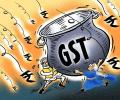
GST collections jumped 15 per cent to nearly Rs 1.68 lakh crore in November, the finance ministry said on Friday. Goods and Services Tax (GST) mop-up was over Rs 1.45 lakh crore in November 2022.

Production of eight infrastructure sectors expanded by 7.9 per cent in September -- the highest in three months -- on account of better show by coal, fertiliser, cement and electricity segments, according to official data released on Monday. In September last year, the growth rate stood at 5.4 per cent. It was 4.1 per cent in August. The previous high was in June when the output expanded by 13.1 per cent.

India's gross tax revenue, comprising both direct and indirect taxes between April and July, reported a growth rate of merely 2.8 per cent to Rs 8.9 trillion compared to the same period a year ago, as shown by government data on Thursday. This growth was dampened by direct tax figures, offsetting the healthy growth in goods and services tax collections and Customs duties. While net tax revenue contracted by 12.6 per cent to Rs 5.8 trillion up to July, accounting for 25 per cent of the Rs 23.3 trillion full-year target, this could be attributed to the increased tax devolution to states during the period.

The Interim Budget for 2024-25 (FY25) to be presented on February 1 is likely to assume 10-10.5 per cent nominal gross domestic product (GDP) growth against 8.9 per cent estimated for FY24 by the National Statistical Office (NSO). "We were waiting for the First Advance Estimates GDP numbers for FY24. "We will finalise the nominal GDP growth assumption for FY25 Interim Budget in a couple of days.

The economic growth may have slowed to 3.5 per cent in fourth quarter of 2021-22 from 5.4 per cent in the previous three-month period due to the impact of higher commodity prices on margins, decline in wheat yields and on higher base, Icra Ratings said on Monday. The agency said the hiccups in the recovery of the contact-intensive services attributable to the third wave of Covid-19 in the country may have also affected the economic growth in the quarter. Even the gross value added (GVA) at basic prices (at constant 2011-12 prices) in Q4 FY2022 seems to have eased to 2.7 per cent from 4.7 per cent in Q3 FY2022, it said.
In November, the fiscal deficit widened by Rs 2.2 trillion, the highest ever in any month this financial year.
Retail inflation declined to 6.83 per cent in August after touching a 15-month high of 7.44 per cent in July, mainly due to softening prices of vegetables, but still remains above the Reserve Bank's comfort zone. The overall inflation in the food basket stood at 9.94 per cent in August as against 11.51 per cent in July, according to data released by the National Statistical Office (NSO) on Tuesday. Retail inflation based on the Consumer Price Index (CPI) was at 7 per cent in August 2022.

Production of eight infrastructure sectors increased by 5.4 per cent in November against a 3.2 per cent growth in the same month last year on a better show by coal, fertiliser, steel, cement and electricity segments, according to the official data released on Friday. Crude oil, natural gas and refinery products, however, recorded negative growth in November this year. The production growth of eight key sectors slowed down to 0.9 per cent in October.

The output of eight core infrastructure sectors grew marginally by 0.1 per cent in January, mainly due to growth in the production of fertiliser, steel and electricity. The core sectors had expanded by 2.2 per cent in January 2020, according to the provisional data released by the commerce and industry ministry on Friday. Coal, crude oil, natural gas, refinery products, and cement recorded negative growth in January.
India's current account deficit declined sharply to 1 per cent of the GDP or $8.3 billion in the second quarter of this financial year, mainly due to lower merchandise trade deficit and growth in services exports, according to a RBI data released on Tuesday. The current account deficit (CAD), which represents the difference between the total amount of money sent abroad and money received from overseas across the economy, was 3.8 per cent of GDP or $30.9 billion in the July-September quarter in 2022-23. CAD was $9.2 billion or 1.1 per cent of GDP in the first quarter (April-June) of the current financial year 2023-24.

The wholesale price-based inflation spiked to 12.54 per cent in October, mainly due to rise in prices of manufactured products and crude petroleum. WPI inflation has remained in double digit for the seventh consecutive month beginning April. Inflation in September this year was at 10.66 per cent, while in October 2020 it was at 1.31 per cent.

India's merchandise exports in June rose by 16.78 per cent year-on-year to $37.94 billion while the trade deficit ballooned to a record $25.63 billion on account of a steep increase in gold and crude oil imports, according to the government's preliminary data released on Monday. The export growth in June moderated from 20.55 per cent in May and 48.34 per cent in June 2021. During the month under review, exports of engineering, pharmaceutical and plastic products recorded negative growth.

Analysts and economists have hailed the fiscal projections in the interim Budget, saying the lower fiscal deficit forecast shows that the government, even in an election year, is serious about fiscal consolidation and that the numbers look achievable. According to Devendra Kumar Pant, the chief economist at India Ratings, the two broad themes of the interim Budget are fiscal consolidation and stepping up focus on agriculture/rural to course correct, to some extent, the differential benefits of the ongoing economic growth that's tilted in favour of upper-income bracket/urban households. The projected fiscal deficit numbers for FY24 and FY25 suggest that the government is serious about achieving the fiscal consolidation path of 4.5 per cent fiscal deficit by FY26, and given the nominal GDP growth assumption and revenue buoyancy, the target appears plausible, Pant said in a note.

Moody's on Thursday upped India's growth projection for the next financial year beginning April 1, to 13.7 per cent, from 10.8 per cent estimated earlier, on the back of normalisation of activity and growing confidence in the market with the rollout of COVID-19 vaccine. For current fiscal, the US-based rating agency expects the economy to contract 7 per cent, lower than its previous estimate of 10.6 per cent contraction.

India's industrial production contracted by 4 per cent in October, the sharpest fall in 26 months, mainly due to decline in output of manufacturing and subdued performance of mining and power generation sectors, according to official data released on Monday. The Index of Industrial Production (IIP) had grown 4.2 per cent in October 2021. The previous low was (-) 7.1 per cent in August 2020.

The states will forego around Rs 44,000 crore of tax revenue after they reduced VAT on petrol and diesel in the reminder of the fiscal but higher central tax devolution of Rs 60,000 crore will offset the losses, according to a report. After months of calls for lowering the taxes on the fuels, the Centre on November 4 cut excise duty on diesel by Rs 10 a litre and by Rs 5 on petrol. Following this, as many as 25 states and Union territories have lowered value-added tax (VAT) on these fuels.
Retail inflation dipped marginally to 6.44 per cent in February, mainly on account of a slight easing in prices of food and fuel items though it remained above the Reserve Bank's comfort level of 6 per cent for the second month in a row. As per the government data released on Monday, the Consumer Price Index (CPI)-based inflation was at 6.52 per cent in January and 6.07 per cent in February 2022. The retail inflation rate for the food basket worked out to be 5.95 per cent in February, marginally lower than 6 per cent in January.
Retail inflation declined to an 18-month low of 4.7 per cent in April mainly due to falling prices of vegetables, oils and fats, and came closer to Reserve Bank's target of 4 per cent, showed government data released Friday. It was for the second month in a row that Consumer Price Index (CPI) based inflation remained within the RBI's comfort zone of below 6 per cent. The government has tasked the central bank to ensure retail inflation remains at 4 per cent with a margin of 2 per cent on either side.
Retail inflation jumped to a 15-month high of 7.44 per cent in July as prices of vegetables and other food items spiked, according to official data released on Monday. The Consumer Price Index (CPI) based inflation was at 4.87 in June and 6.71 per cent in July 2022. Previously, high inflation was recorded at 7.79 per cent in April 2022.
